This blog's poems are from my published poetry book Star Steeds and Other Dreams: The Collected Poems (CFZ Press: Bideford, 2009) and are © Dr Karl P.N. Shuker, 2009. Except for author-credited review purposes, it is strictly forbidden to reproduce any of these poems elsewhere, either in part or in entirety, by any means, without my written permission.

How to purchase Star Steeds and Other Dreams

If you wish to buy this book, which is 230 pages long and is ISBN 978-1-905723-40-9, it is readily available online from its publisher, CFZ Press of Bideford, Devon, UK at http://www.cfz.org.uk/ and also from such major literary websites as Amazon, Barnes & Noble, Waterstones, W H Smith, and sellers on AbeBooks to name but a few. You can also purchase a signed copy directly from me, the author - please email me at karlshuker@aol.com for full details.

Available from Amazon.com , from Amazon.co.uk , and directly from the publisher in quantities at: www.cfz.org.uk.


Dr Karl Shuker's Official Website - http://www.karlshuker.com/index.htm


IMPORTANT:
To view a complete, regularly-updated listing of my Shuker In MovieLand blog's articles (each one instantly clickable), please click HERE!

IMPORTANT:

To view a complete, regularly-updated listing of my ShukerNature blog's articles (each one instantly clickable), please click HERE!

IMPORTANT:
To view a complete, regularly-updated listing of my RebelBikerDude's AI Biker Art's thematic text & picture galleties (each one instantly clickable), please click HERE!

IMPORTANT:
To view a complete, regularly-updated listing of my Starsteeds blog's poetry and other lyrical writings (each one instantly clickable), please click HERE!

IMPORTANT:
To view a complete, regularly-updated listing of my Eclectarium blog's articles (each one instantly clickable), please click HERE!


Search This Blog


Showing posts with label God. Show all posts

Sunday, 1 April 2018

FIVE YEARS AGO


Five years have gone by since the passing of my dear mother, Mary Shuker. Sometimes it seems like only moments ago, other times an eternity, a different life in a different world. How I miss you Mom, how I love you and wish with all my heart that you were still here with me, sharing my life, making it worth living again, a real life instead of a sham existence.


FIVE YEARS AGO

Five years ago today, Mom, you left my life, you left this world – and my life, my world, was left lifeless, worldless, without you. So it remains today, and so it will always remain, until we are together once more, all of us, our family, reunited at last and forever. Friends tell me that you have never left me, that you are still here, all about me, always. I am reminded by their words of other words - those attributed to Hakim Sanai, a 12th-Century Persian poet:

Unable to perceive the shape of you,
I find you all around me.
Your presence fills my eyes with your love,
It humbles my heart,
For you are everywhere.

How I wish, how I hope, how I pray that this is so, and, above all else, that even if only once ever, but at least just once, I could know this for certain, beyond any doubt, beyond any shadow or whisper or flicker of hesitation, know that you were indeed here still, filling my soul with your love that was always there for me when you lived beside me in my life, when you walked with me in my world.

Then again, perhaps it is a test, a test of faith - just like Orpheus faced when walking out of the Underworld in the fervent hope that his deceased bride Eurydice was indeed following behind him, but Orpheus failed to win her back when he finally gave in to the temptation of doubt and looked behind him to make sure that she really was there, and, in so doing, lost her a second time, and this time for all time. Perhaps my test is to draw upon and have faith in my memories of your love for me, upon my certain knowledge that as long as you are in any way able to stay close by, you will indeed do so, never leaving or abandoning me, but instead always here for me, watching over me, guiding me as ever, until my own time here is complete - and that as long as I believe this to be so, so shall it be. Only if my mortal doubts overcome me will I lose you here again, a second time, Mom.

So, on this day, of all days, I must overcome any doubts, any fears, and for all time, because I will not lose you again - never! - and henceforth I will continue, in whatever role God intends for me here on His Earth, until in His mercy I am finally at peace and at last restored to you, to all of us, in His Heaven, never more to be parted.

God bless you, Mom, may I always be worthy of you, as the son you loved so much when you lived beside me in this world, and as the son whose love for you lives on in this world, and always will do, through all the days of my own life here, however many or few those may be.

My mother Mary Shuker (© Dr Karl Shuker)


Sunday, 14 October 2012

MAY IT BE


2012 was not the best of years for me, but 2013 proved infinitely worse, because that was the devastating, accursed year that took from me my dear mother, Mary Shuker; the following poem is my way of expressing what has been, is, and (I hope) will be.


MAY IT BE

What if I should gain the whole world yet lose all happiness within it?
What if I should gain immortality yet lose all those whom I love?
What if I should gain eternity yet lose you forever, my Lord and Father?
The shadows and darkness have pursued me for so long, O God,
And only you can dispel them and illuminate my life once more.
Hear my voice in the night, calling out to you from the depths of my despair,
Let your benevolence ward off the malevolence encompassing me,
Guide me safely into the welcoming light of morning,
And may the salvation that I seek be mine at last.


Friday, 20 April 2012

THE MONASTERY


Time-slips are fascinating if baffling concepts, which I have utilised in this story poem. Although I haven’t stated it explicitly, I’m sure you’ll realise that instead of the monk being in the distant past (as the child narrating this poem assumes), in reality he is in the distant future, because the finding of the Cross after meeting the monk inspires the child to become a monk – the monk. In other words, the monk that the child meets is himself, as he will become in the future.

THE MONASTERY

One pleasant country afternoon
Through lonely woods I strolled,
When hazy mists began to fall
In swirling cloudy folds
And blinded every beam of light,
None penetrating through,
Until at last the mists dispersed,
And rose through skies of blue.

I looked around, and then I saw
A monastery, concealed
By glades of trees and tiny flowers
That edged each greening field.
A pretty garden lay all round
The monastery, so fair
With trees in blossom, budding flowers,
Whose sweet scent filled the air.

And high above, unseen by all,
A singing nightingale,
Whose liquid trills and lilting notes
Sailed through each wooded vale.
Sing sweetly, little philomel,
Bring happiness to all –
Shy minstrel of the dusky night,
Of silent eveningfall.

And through this garden walked a monk,
A prayer book in his hand.
He heard the nightingale, and smiled
To hear the merry band
Of feathered singers in the trees,
As thrushes joined the choir,
Till warbling music filled the air
As breezes sent it higher.

And velvet bumblebees buzzed near
Each nectar-brimming flower,
While gaily-spotted ladybirds
Flew by from bloom to bower.
And as he saw each tiny life,
The monk’s heart filled with joy,
As he remembered happy days
When he was once a boy –

A quiet boy who loved God’s works
Of beauty, true and mild.
And so his life he gave to God,
To seek our Lord’s paths mild.
But now he turned, and passed from sight
Beyond the shadowed trees,
And then another mist appeared,
Upon the evening breeze.

And when it lifted from my eyes,
The monastery had gone.
And as for garden, glades, and flowers,
Of these there now was none.
For all were ghosts from other times,
Those realms of glades and moss.
But then, beneath a grassy bower,
I spied a golden Cross –

The Cross that hung around the neck
Of that mild monk I saw.
A Sign that spanned the straits of Time
To lie on grass before
A silent child in country lanes
Whose youthful fears now thawed.
Yes, blessed are the pure in heart,
For they shall see the Lord.

Thursday, 12 January 2012

WHAT IS GOD?


How many times – countless, assuredly – has the question forming the title of this poem been asked and pondered over by thinkers of every nation across the globe and through all the ages of human existence? Here are my own thoughts.

WHAT IS GOD?

Lone I sat upon a mountain
Captured long by silent thought.
“What is God?” I wondered softly,
As illusions round me fought

To attract my mind’s attention
While I sat beneath the skies.
And the hush of peace drew slowly
O’er this cloudy world of sighs.

For the Voice of God was present –
Not the clamour of alarm,
Or the roar of wreaking earthquakes,
Just a quiet Voice of Calm.

“What is God?” I wondered, seeking
One who ne’er to me has lied.
And my Conscience answered softly –
“I am God,” its voice replied.

“I am God within each mortal.
I – who speaks amid the fire.
I – the diamond in the darkness.
I – the rose upon the briar,

“Leading all who live untempted
By the guiling tones of Harm,
Or the cunning wiles of Hatred,
Or by Envy’s bitter charm.

“I am He Who walks unnoticed
In sweet Virtue’s world of balm,
And the isles of Hope and Freedom;
I – a quiet Voice of Calm.”

And as Night with veils of Shadow
Cloaked the sunset splashed with red,
I at last knew what my God was:
“I am God,” my Conscience said.

Thursday, 16 June 2011

THE SILENCE OF SOLITUDE


It has often been said, and it is perfectly true, that each of us enters and leaves this world alone, but it is also true that many spend much of their allotted time here in solitude too, with only silence and the stars above for company.

THE SILENCE OF SOLITUDE

Within these dappled vales of Space
My seeking mind is found,
Amid the empty pools of Time
That softly pivot round;
For silence, long and endless, here
Is e’er the only sound.

But in this plane of nothingness
My mind can find release
From human woes and human grief,
For here, all failings cease
To be, among the silence of
This citadel of peace.

And here, my weeping tears and sighs
Can drift unseen away,
For who can know my silent doom
That lingers through each day.
For me, the loneliness I hold
No words could e’er convey.

And oft I gaze unseeing through
These misty realms of Space,
And wonder at the sadness of
The thoughts that swiftly race
Across the pale illusion of
My silent, sombre face.

Yes, I know more of loneliness
Than I could ever say,
As silently I’ve walked alone
Along its dismal way,
Till far ahead a Light has shone
To clarify my day.

So many times I’ve wondered why
I should be on my own,
While others reap their harvests in
From fields they haven’t sown,
Then leave me there in silence as
I gather mine alone.

But I have long since realised
That I must strive alone
If I am e’er to find the life
I seek to claim my own,
By reaping only where I know
My silent work has sown.

So, silently, mankind may frown
To hear my wistful tones,
But e’en in death my soul must flit
Through Heaven’s Door alone,
To kneel before the Glory of
God’s everlasting Throne.

So let them stare, for onwards still
My thoughts must stream and pour,
If I am e’er to navigate
Beyond this present shore,
And stand amidst the silence of
The Future’s open door.

Monday, 13 June 2011

THE TRANSFORMATION OF SAINT EUSTACIUS


Certain religious stories, such as St George and the Dragon, have generated very considerable interest down through the centuries and have become extremely well known, but there are others that have attracted much less notice, yet are no less memorable. The following story is one of these hitherto-neglected Christian legends, which has always stayed in my mind ever since I first read it many years ago, so I finally decided to retell it in verse.

THE TRANSFORMATION OF SAINT EUSTACIUS

Through the emerald forests
Of golden-hued Dawn,
Rode Eustacius, a soldier
Of Rome, one fine morn,
As his hounds bayed all round him
With dark, fearful eyes,
Like a torrent of shadows
‘Neath newly-born skies.

So the soldier rode onward
Through golden-leaved trees,
While the hounds’ dismal howling
Still hung on the breeze
Like a dream half-forgotten
‘Twixt Future and Past –
Yet still doomed by its maker
Forever to last.

Then ahead of Eustacius
A white stag appeared,
And the soldier’s steed trembled,
Then, shivering, reared.
Just as if the stag’s presence
Imbued it with awe,
As the hunter peered onwards
And then, the deer, saw.

All at once, the stag stiffened,
Then fled through the trees,
But Eustacius pursued it,
Through clearings and lees.
On he chased this white wonder,
Past mountains and vales,
And the morn became noontide
In forests and dales.

Later, Evening drew gently
The curtains of Night
Far across the blue heavens,
Now dappled with light
From the glistening stars set
In countless array,
Each a tiny eye peering
Through blankets of grey.

And as they witnessed softly
The hunt far below,
E’en the moon wept in sadness,
And shrouded its glow
To give cover of darkness
‘Midst shadowy glades
To the hunted stag, weary
As still the hounds bayed.

But the stag was now tiring,
Its head dangled low,
As its heart heaved and pounded,
Its eyes full of woe,
Till it sank down exhausted
On carpets of dew,
As the hounds’ ghastly howling
More terrible grew.

Then Eustacius perceived it,
Stretched outwards to die,
As its fragile heart throbbed ‘neath
The sorrowful sky.
And the stag watched the soldier
With eyes dark and mild,
For it made no swift movement,
Yet cried like a child.

Then a pale shaft of moonlight
Fell softly from Space,
And its shimmering beauty
Lit up the deer’s face.
And as all the world waited,
The stag raised its head.
Its mouth opened, and then, with
A human voice, said:

“Why dost thou still pursueth
Me long through the trees?
I am Christ,” as Eustacius
Dropped low to his knees.
For the stag was surrounded
By radiant light,
Like a star incandescent
That passed from all sight

To the heavens resplendent
In Glory Divine.
Then Eustacius looked up, and
Drew slowly the Sign
Of the Cross there before him –
A new saint was born,
In the reincarnation
Of God’s golden Dawn.

Monday, 25 April 2011

THE ROBIN AND THE CROSSBILL


There are many traditional, quite often poignant religious folktales featuring animals, some of which are well known, others less so. In the following poem, I have combined two of these age-old stories, both of which are Easter-themed - the famous legend of how the robin gained its red breast, and the less familiar legend of how the crossbill acquired its twisted beak.

THE ROBIN AND THE CROSSBILL

A tall wooden Cross cast its pitiless shadow
Across a green hill ‘neath the grey, leaden sky.
For mankind had crucified Jesus, its Saviour,
And left Him there helpless to suffer and die.

But two tiny birds came to visit Lord Jesus,
Two small humble creatures with hearts full of love.
The little brown robin and bright crimson crossbill,
Each blessed by the Light of their Father Above.

When Jesus looked down and beheld the small robin,
He smiled at him softly, and down from His breast
His blood trickled slowly like deep scarlet teardrops,
And falling below stained the robin’s white chest.

The crossbill in vain used his bill to remove the
Cruel nails that impaled Jesus’ hands and His feet,
But prised with such force that his bill crossed and twisted
‘Ere, strength being spent, he conceded defeat.

And e’er since that day when they visited Jesus,
The bill of each crossbill is twisted and curled,
While Jesus’ red blood on each robin’s chest lingers,
Reminding us just how much God loves our world.

Monday, 28 February 2011

HEAVEN'S BELL


The following poem of mine was inspired by a beautifully-written short story (entitled ‘The Bell’) penned long ago by Hans Christian Andersen – one of my poetry’s most influential muses.

HEAVEN'S BELL

Morning rose slowly through pale, dreaming cloudlets,
Peering down softly from clear, violet skies,
Watching the countryside waking from slumber,
Sending forth sunlight from warm golden eyes.

And as the song of the warbling dawn chorus
Drifted in ripples of carolling darts,
Church bells pealed gaily their glorious chansons,
Born from the joy of their bright, silver hearts.

Yet, ‘midst the chimes of their vibrant crescendo,
Echoed the sound of a more distant bell,
Deep and majestic in strange, holy splendour,
Singing unseen through each woodland and dell.

Rich was its tone, like a solemn concerto
Borne from a World of Perfection and Truth,
Calling me onwards through dingle and forest,
Haunting the wandering soul of my youth.

Snow-white anemones listened in silence,
Bowing down low as its heavenly chimes
Rang out before me in infinite glory,
Growing more fair with the passage of Time.

And as I walked through viridian woodlands,
Lilac convolvuli trumpeted long,
While from the arbours the bell’s regal chorus
Softly resounded through hyacinth throngs.

Still I continued, past silver-lit lakesides,
And as the swans drifted softly from sight,
Leaving their shadows on deep turquoise waters,
Far up ahead shone a shimmering light.

And as I passed through the lavender mountains,
Seeking the bell that had called from afar,
Fountains danced brightly from woodland to valley,
Spraying the vales with a bright shower of stars.

Meadows lay glistening on in the distance,
Dappled with poppies in slumbering bliss,
Peacefully dreaming in rapturous beauty,
Wrapped in enchantment by Summer’s soft kiss.

And as I climbed to the grey, cloudy summit,
Sunset spread softly through brilliant skies,
Filling the world with its rosy suffusion,
Scorching with colour my wondering eyes.

And as the sun sank down softly through Heaven,
There, ‘neath the sky, lay the glittering sea,
Snaring the sun’s silhouetted reflection –
Here, if at all, would the bell surely be.

Lo! What magnificence! Lo! What resplendence!
There stood the sun like an altar of gold,
Raised o’er the sea as a shimmering halo,
Kissed by the ocean’s voluptuous folds.

Here was the wondrous Cathedral of Nature –
Pillars of willow, and Heaven its dome,
Singing of Beauty, of Love in the Highest,
Borne from the chorus of wavelet and foam.

Stars twinkled brightly like crystalline lanterns,
Lighting up softly the pathways of Night,
Casting their shadows like glittering diamonds
Down to the woodlands in crescents of light.

And, as I stood ‘neath the Archway of Heaven,
Nature and Poetry singing as one,
Still the invisible Bell rang above me,
Calling me ever more, upwards and on,

Singing of God, of His Power and His Promise,
Sending His Love in melodious chords,
Borne by the souls of the Blessèd forever –
Praise in excelsis, for theirs is the Lord!

Tuesday, 28 December 2010

THE ANGEL


Ever since childhood I have adored the fairy tales of Hans Christian Andersen, but I have always questioned whether they were truly intended for children, as many of them seem much too complex, lyrical, and often too dark for young minds to appreciate fully. Over the years, I have adapted a number of them to yield narrative poems, including this one, which is based upon my all-time favourite Andersen story.

THE ANGEL

Day was fading like a phantom
As the evening softly drew
Spangled veils above each village,
And the moon’s pale radiance grew.
Stars lit up the sable heavens
With their softly twinkling light,
Like a host of spectral lanterns
From the valleys of the night.

But below their twilit kingdom
Flew a shining image mild –
There, an angel, bearing gently
In its lovely arms a child.
For the child had died that evening,
And the angel bore it long,
As it spoke in blissful murmurs
Like a peaceful, dulcet song:

“When a good child dies, an angel
Flits from Heaven’s golden Bliss,
And embraces long this infant
With a warm and tender kiss.
Then it spreads its wings like crescents
Soaring brightly through the sky,
And with joy it takes the infant,
As through all the world they fly,
To the lands where once this youngster
Had found Happiness and Peace,
Where they gather sprigs of flowers
Whose souls then will meet release,
And will bloom with lasting beauty
In the bliss of Heaven’s calm.
But the flower the child loved dearest
Will receive a voice of balm,
And will sing with all the angels
Each rejoicing psalm and chord
In a universal chorus
Praising ever more our Lord.”

And the youngster listened softly
In a tranquil, peaceful dream,
As they passed through lovely gardens,
Over woodland vales and streams,
To the lands in which the infant
Spent its most delightful hours,
Where they’d stay to gather bouquets
Of the most resplendent flowers.

Here they saw a fragrant rose tree,
Now forgotten, all alone.
For its stem had once been broken
When the buds were but half-grown.
Now they drooped in wilting sadness,
Though the rose was still in bloom,
So enchanting, as it waited
For its end, its final tomb.

And the child sighed long, and murmured:
“Pray, dear Angel, take it too,
So that once again, in Heaven,
It may live and bloom anew.”
And the angel kissed the infant,
As it plucked the wilted rose;
And the infant’s eyes half-opened,
For they wanted not to close.
Thus they gathered many flowers:
Some were beautiful and fair,
But amidst their sprigs, the lowly
Buttercup was also there.
And the happy child spoke softly:
“We have flowers now,” he said.
And the lovely wingèd angel
Smiled, and nodded then his head.

Yet they flew not up to Heaven,
Still remaining in the town,
Which lay sleeping in the shadows
Of the evening’s dusky gown.
For they hovered long in silence
O’er a dark and narrow street
Where a rubbish pile lay, trampled
By the shoes of many feet.
And the angel pointed downwards
To a dim, deserted spot
Where a large white flower lay shrivelled
By a broken plaster pot.
For the flower had been discarded,
Thrown away and left to die.
But the angel said: “This also
We shall take, and as we fly
Up to Heaven I shall tell you
Then the story of this flower”.
So they onwards flew, as Morning
Lit the dawn’s first rosy hour

“There, below,” the angel murmured,
“Lived a sick, bedridden boy,
In a cellar where the sunlight
Was his comfort and his joy
When on crutches he could hobble
Round his tiny, darkened room,
As the sun’s caressing shaftlets
Filtered softly through its gloom.
And, when on such days he sat there,
Bony fingers thin and red
With the flow of blood within them,
“He’s been out,” his parents said.

“One fair spring, the neighbour’s youngster
Brought a leafy beech tree bough,
Which the poor sick boy would dangle
O’er his head, and wonder how
Bright and happy he would be if
He could sit beneath the trees
In the forest every summer
‘Midst the coolness of the breeze.

“Then the neighbour’s son collected
Many sprigs of springtime flowers
From the woodlands’ verdant arbours
And the valleys’ leafy bowers.
And amongst them was a white flower
With its fragile roots preserved,
Which, when watered in a plant pot,
As a small flower garden served.
Thus it flourished, sending blossom
Forth each sunny summer’s day,
And it gave him hope and comfort
In its simple humble way.
Soon it entered e’en his dreamworld,
As it bloomed for him alone.
And as e’er he watched, it seemed that
Even fairer had it grown.
For its beauty was his pleasure,
And its spirit was his breath.
And towards his flower, forever,
Still the boy turned, e’en in death.

“For a year the flower had stood there,
Lone, forgotten by the world
When the boy flew up to Heaven
Where a new World lay unfurled.
And when finally his parents
Moved away to other lands,
They forgot the drooping flower, and
So it met with stony hands,
For into the street they threw it,
Like an old and broken toy.
But the happiness and comfort
That it brought to that sick boy
Is the reason we have placed it
In our nosegay with the rest.”
And the child was filled with pleasure,
As with wonder was he blessed.

“Yet how knowest you of all this?”
Asked the small, enquiring child.
And the angel answered gently
With a murmur calm and mild:
“Every word I spoke is true, and
Now the answer I shall tell –
For I was myself that sick boy,
Yes, I know my dear flower well.”

And the infant’s eyes were opened,
Filled with Happiness and Love,
For they then, at that same moment,
Were in Heaven far Above.
And the infant, like the angel,
Now had sweeping snowy wings.
And together flew they softly
Hand in hand, in endless rings,
While, their lives renewed forever,
All their flowers bloomed full of joy.
But the happiest by far was
Still the small flower of the boy,
For it gained a voice in Heaven,
And with blessed delight it sang
With the seraphim forever
As the chimes of Heaven rang.
For the wondrous bliss of Heaven
Stretches on without an end.
And fore’er its peaceful radiance
Shall, to all, God’s message send.

But of all God’s great creations
Shaped by loving Hands of Power,
None could be more truly happy
Than that white once-withered flower,
Which sang ever to its Father,
For its joy was now complete,
Saved from Death and borne to Glory
From a dark and narrow street.

Monday, 20 December 2010

THE CHRISTMAS DONKEY


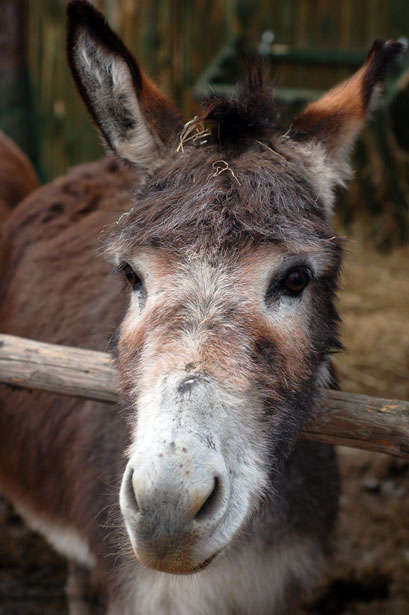
This poem borrows, adapts, and interweaves a number of separate strands – the legend that the cruciform marking present on every donkey’s back was placed there by Jesus in gratitude for being carried by one of their kind during His triumphant procession into Jerusalem on the first Palm Sunday; the idea of that particular donkey being granted immortality, so that it has secretly survived in unchanging form down through all the centuries into the present day; and its chance discovery one Christmas morning by a group of children who have no idea of its origin or significance.

THE CHRISTMAS DONKEY

Christmas drifts silently downwards ‘ere Morning
Rises from dreams through the depths of the sky,
Softly caressing each child wrapped in slumber –
Sleeping in peace as the stars twinkle by.

And in a field stands a little brown donkey,
Gazing through Space from an icicled world,
Nuzzling the snow with his soft velvet muzzle,
Shaking its crystals from eyelashes curled.

Now, as he pauses, the dawn flushes brightly,
Blushing like rose petals strewn from Above,
Waking the children with murmurs from Morning,
Carolling joyfully anthems of Love.

Soon they chase merrily into the garden,
And as they sing of what Christmas will yield,
One of them points to the little brown donkey,
Standing alone in the snow-covered field.

Swiftly they race through the shimmering snowflakes,
Up to his paddock with eager delight,
Each to embrace him with warm, tender kisses,
Melting the snow in its spiralling flight.

And as he brays in the midst of the children,
Gaily they deck him with tinsel and flowers –
Joyfully plucked from their Christmas tree’s branches –
Glistening brightly in colourful showers.

But as the heavens’ first frost-killing sunlight
Glints from each bauble and gleams from each boss,
Softly a shadow falls over his shoulders,
Sombre and still in the shape of a Cross.

And as he stands there, a tear trickles slowly
Down through his lashes in sorrowful flight,
As he remembers through centuries countless,
Whom he’d once carried with love and delight.

Palms and hosannas regaled him in triumph,
There on his back sat our Saviour and Lord,
Smiling and nodding to people and children,
Standing all round in a vast, cheering hoard.

“Why did they spurn Him, betray Him, and kill Him –
Nailed to that Cross and then left there to die?”
Still the poor donkey weeps long at the memory,
Held for Eternity deep in his eyes.

And as the children, not seeing his sorrow,
Run away laughing, the donkey’s warm heart
Burns with a passionate love so intense that
Not e’en the chill of the icicles’ darts

E’er could refrigerate, e’er could extinguish,
Burning in silence this cold Christmas Day,
Lingering still, like the Cross’s dark shadow –
Borne from a green hill so far, far away.

Friday, 12 November 2010

THE MONASTERY GARDEN


It was my mother who introduced me to the evocative light-classical compositions of English composer Albert Ketèlbey (1875-1959). Many of his best-loved compositions were thematic, such as ‘In a Chinese Temple Garden’, ‘In a Persian Market’, ‘In the Mystic Land of Egypt’, and perhaps his most famous work of all, ‘In a Monastery Garden’. It was while listening to this lovely composition one afternoon that the idea came for the following poem, which I duly wrote while the strains of Ketèlbey’s music played on, inspiring and shaping it into its final form.

THE MONASTERY GARDEN

Out of the nightmare of War’s raging battle
Struggled two soldiers away from the field,
Walking in silence so far from their homeland,
Hoping that somewhere a vision would yield,

One that would show them why War must continue,
Why they must struggle when all else seems lost,
Why so much bloodshed should lie over Europe,
Death being Victory’s ultimate cost.

And as they wandered, they heard from a clearing
Singing and psalms drifting softly all round,
As in the branches a nightingale’s lilting
Filled all the vales with melodious sound.

There, up ahead, lay a monastery’s garden,
Golden and peaceful in sun-dappled bliss;
Fountains danced brightly in dazzling crescendos,
Flowers stretched up longing for sunlight’s warm kiss.

Here the two paused, looking into the garden;
Then to the gate they approached side by side,
Gazed for a time, and, refreshed by its beauty,
Opened it slowly and entered inside.

And in the wonder and peace of the garden,
Each sat there thinking of all that was past,
Knowing that they could reshape the world’s future,
Knowing that freedom forever could last.

Blossom fell gently upon the two soldiers,
Fragrant and fragile as transient dreams,
Bringing them sleep to escape from the fighting,
Hiding War’s shadow with Light’s golden beams.

And in their dream stood an Angel of Mercy,
Towering over the spectres of War,
Till, when his countenance gazed on these phantoms,
Each one was shrivelled, and War was no more.

Now, when they woke, they possessed a new wisdom,
Knowing at last what their fighting must bring;
Blessed with new Hope ‘midst Despair’s cloak of Panic,
Hearing the churchbells for Victory ring.

And as they sat there, they talked of the battle,
Each one now conquering War’s bitter Dread.
Then, as the first paused in thought for a moment,
Up stood the other in silence, and said:

“Never has so much been lost by so many,
Lost in the dream of a kingdom of Peace,
Hoping their sons will be born into Freedom,
Praying that by their own deaths War will cease.

“Never again must our world be divided,
Fighting in vain for the pleasure of War;
Next time the war will not end with our dying,
Next time our world will be lost ever more.”

Then they walked slowly away from the garden,
Back to the fighting, the guns, and the war.
Yet they knew not of the Presence who watched them,
For they looked back not, and so never saw

There in the garden an Angel stood softly –
He who had sent them their vision of Peace –
Watching them go to a world draped in Sorrow,
Doomed till their fighting could bring them release.

And as they vanished, the Seraph spoke softly:
“Eden was lost to you, children of Greed;
Never again must such war come to being,
Next time from Woe you will never be freed.

“Next time your fighting will be your destruction,
Mankind will wither, and Mankind will die.
And of the world left polluted with Evil,
Only a mushroom will rise through the sky.”
 
Free Hit Counter